
Stitch types
Fill covers an area, satin gives a smooth raised edge, running draws a single light line — and textured fills give an area its own look.
Updated October 19, 2026
Choose a stitch type per element. Fill covers an area, satin gives a smooth raised edge for lettering and borders, and running creates a single light line. Contour, circular, guided and meander fills, cross stitch and ripple give an area its own texture.
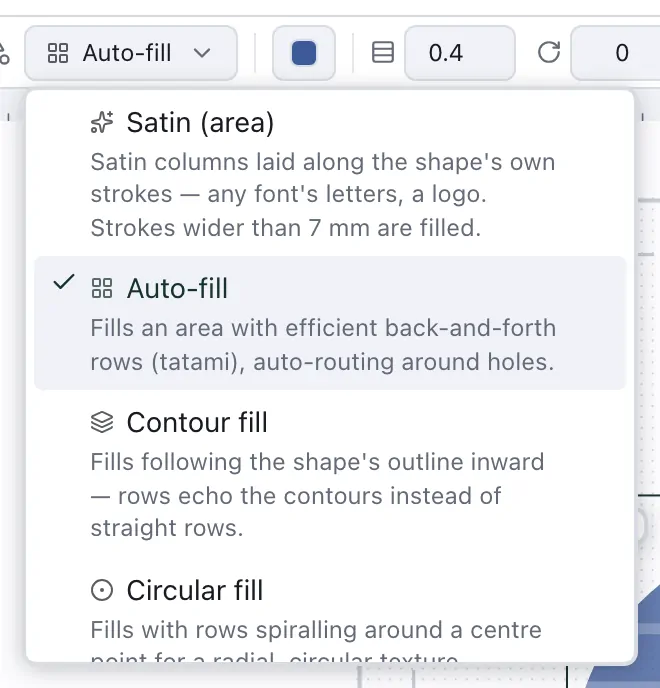
Select an element, switch to the Stitch view and pick its type under Type in the bar above the canvas. The list offers the types that fit the shape first; the rest are greyed out at the end under Doesn't fit the selection, each with the reason. The change shows straight away:
Satin
A satin column is a line with a width. Draw the line along the column's middle with the Pen / Path and choose Satin column as its type: it is sewn 3 mm wide, and Width in the bar makes it wider or narrower. A satin drawn with two rails — its two edges — works too. For a closed shape, choose Satin (area), which lays satin along the shape's own strokes, as in letters or a logo, and fills strokes wider than 7 mm; there Satin column is greyed out with the hint “For a satin border: Outline ▸ Satin”, because a satin border round a shape is its Outline set to Satin.
Besides Width, the bar sets Spacing (smaller is denser), Pull, which widens the stitches so the column keeps its width when the thread pulls the fabric in, and Method; Underlay switches on the layer sewn beneath. Stitch settings in the right rail hold the rest, such as a taper at either end.
Fill and underlay
A fill sews rows back and forth across the area. Under them you can switch on an underlay: a sparser layer at another angle, sewn first, that holds the fabric flat so the rows on top lie evenly. Fabric that stretches or has a pile needs a stronger underlay.